Reframing data governance for non-data leaders
A practical guide for leaders who don’t want to become data specialists - and shouldn’t have to.
 6 minute read
22 January 2026
Why traditional governance models fail non‑data leaders
Let's be honest: most data governance frameworks were designed by very smart people who love data a little too much. They're full of terms like "metadata lineage", "semantic layers", and "federated stewardship operating models", which is great if you're building a spaceship – but less great if you're just trying to run a business without accidentally breaking a privacy law.
Traditional governance also assumes leaders have endless time, deep technical fluency, and a burning desire to read policy documents (spoiler: they don't). These models over‑index on controls and under‑index on usability and business value. The result is predictable: leaders disengage, governance becomes a checkbox exercise, and everyone quietly hopes the auditors don't show up.
The mindset shift: governance is a leadership capability, not a technical discipline
This is where the rethink begins. Good governance isn't actually about data – it's about leadership. And the leaders who do it well anchor everything in four cornerstones: clarity, confidence, accountability, and practicality.
If you've ever set expectations, managed risk, or tried to stop your team from reinventing the wheel for the fifth time, congratulations: you've already practiced governance. Data governance is simply the structured version of what leaders already do – create clarity about how things should work, build confidence in the information being used, ensure accountability for outcomes, and keep everything practical enough that people actually follow it.
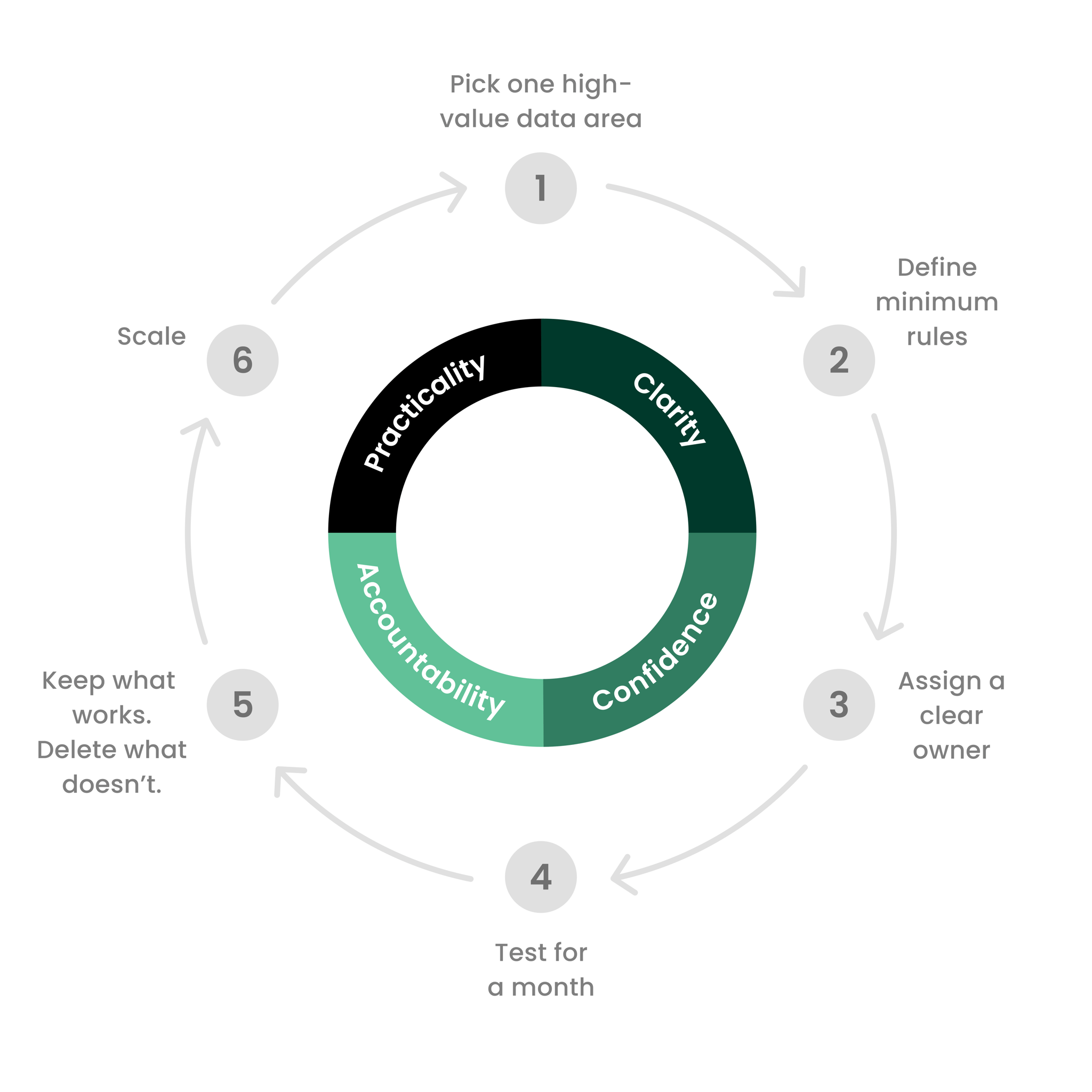
Your leadership capabilities are central to effective governance
Let's reframe
Governance has a branding problem. It sounds like rules, restrictions, and someone telling you "no" in a meeting that should've been an email.
But effective governance is actually the opposite. It's the thing that stops teams from arguing about which dashboard is "the real one". It's what prevents AI pilots from stalling because no one knows who owns the risk. It's what lets leaders move faster because they're not constantly second‑guessing the data in front of them.
Governance is confidence backed by clarity.
A simpler definition: what non‑data leaders actually need to know
Now that we've reframed the mindset, let's make the definition just as simple:
Data governance is how we make sure data is usable, trustworthy, and safe – so people can make better decisions.
That's it. No jargon. No labyrinth of committees. Just a promise that the data you rely on won't betray you at the worst possible moment.
The three questions every leader should ask before any data‑driven initiative
You don't need to understand the inner workings of a data warehouse. You just need three questions that act like a leadership "pre‑flight check" before anything involving data takes off:
- What decisions rely on this data?
If the answer is "important ones", congratulations – governance matters. - What risks actually matter here?
Not theoretical risks. Real ones. The kind that keep you up at night or end up in the news. - Who owns the outcome?
If the answer is "everyone", then the answer is actually "no one".
These three questions aren't just a thinking exercise – they're the backbone of practical governance. They tell you where to focus, how much governance you need, and who needs to be involved. And that leads directly into a lightweight, leader‑friendly way to get started.
Minimum Viable Governance (MVG): turning the three questions into action
Good governance doesn't start with a giant policy document. It starts with using the three questions to shape a small, focused, and actually‑useful governance experiment.
Here's how the Three Questions translate into Minimum Viable Governance:
- Pick one high‑value data area
(Use Question 1: What decisions rely on this data?)
Choose a domain where decisions matter and clarity will make a real difference. - Define the minimum rules needed to stop things going sideways
(Use Question 2: What risks actually matter here?)
Focus only on the risks that are real, likely, or painful – not every risk imaginable. - Assign a clear owner
(Use Question 3: Who owns the outcome?)
One person. One role. One accountable human being. - Test it for a month
Treat governance like a product. Try it. See what breaks. Fix only what matters. - Keep what works. Delete what doesn't.
Governance should evolve based on reality, not theory. - Scale only when people stop rolling their eyes
When teams start saying "this actually helps", you know it's safe to expand.
Minimum Viable Governance is simply the three questions brought to life – practical, human, and refreshingly low‑maintenance.
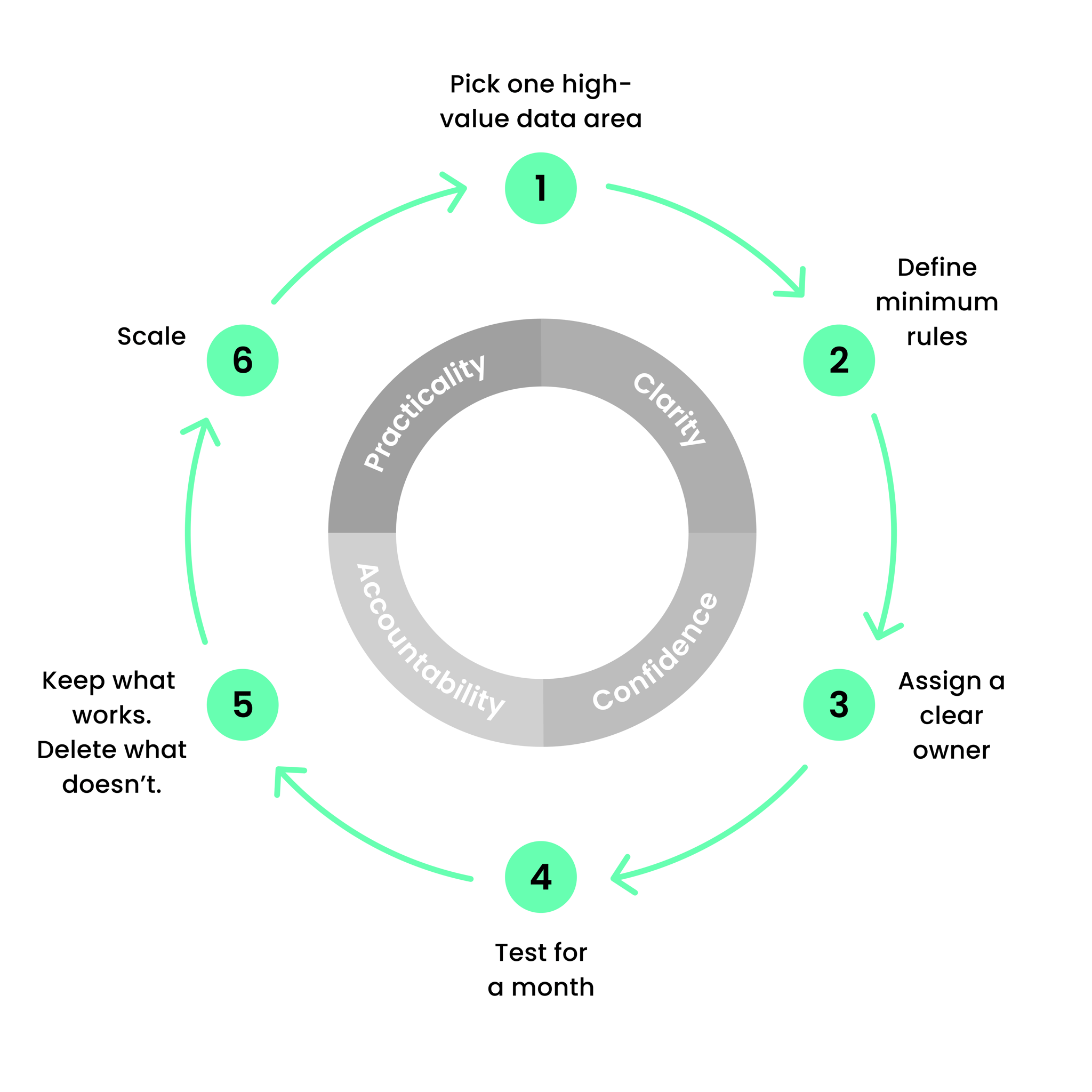
Data governance doesn't have to be monumental, take it one step at a time.
What now?
Start small, lead clearly, build trust. You don’t need to become a data specialist to be an effective leader in a data‑driven world. You just need to take one small step this week: choose a domain, clarify ownership, or ask your team those three magic questions. Remember that governance is a leadership capability, not a technical discipline. Your leadership mindset is the central component in building governance practices that moves your organisation forward in an iterative, low-maintenance way.
Want help putting Minimum Viable Governance into action?
Our team works with leaders to create lightweight, business‑led governance that builds trust without slowing teams down. Explore our Data Governance page to learn more about our services, or contact us directly for practical guidance tailored to your organisation.

Related insights
Share
Other insights





Subscribe to Altis
Join our mailing list to receive the latest updates, expert insights and event news.